Picture

 Artist Profiles


 November / Ernest Briggs - Paint Weaver

Rectangle

Born and raised in southern California, Ernest Briggs studied with the New York School painters Clyfford Still, Mark Rothko and Ad Reinhardt at the San Francisco Art Institute from 1946 to 1951. In 1953 Briggs arrived in New York. In 1954 and 1955 he had solo shows at the Stable Gallery, one of New York's leading venues for avant-garde art in the 1950s and 1960s. He was included in the Whitney Annuals in 1955, 1956 and 1961, and in 1956 was included in the Museum of Modern Art's influential 12 Americans exhibition. From 1961 until his death in 1984, Briggs taught painting at Pratt Institute in Brooklyn.

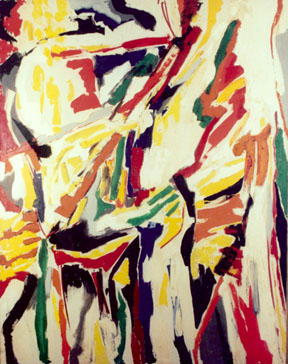
Ernest Briggs was a strong presence within the New York School, but his reputation, like many abstract painters of his generation, was overshadowed by the initial Abstract Expressionist stars that preceded him. But it is interesting to note the relationship between Briggs� paintings and those of the first generation; particularly Still and Pollock.  Briggs was swimming in the same esthetic waters as these two and thus was part of what Harold Rosenberg deemed �Action Painting�.  Briggs� earlier paintings were comparable to Pollock but the later work was more in line with Still. Yet, although a relationship to both artists is evident, Briggs was also clearly his own man.  You see this in how his style both dramatically and subtly shifted as a result of the continued exploration and challenge to his esthetic.  Perhaps because he did not share the same intense 

Picture

Untitled, 1958, 45.5x 34 in

Picture

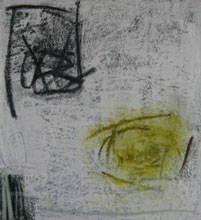
Untitled, 1960s

limelight that a number of the first generation  eventually found themselves in (who had nevertheless earned it after years and years of difficult struggle), Briggs was in many ways a great deal freer.

Look at these paintings and the range of form, color and presentation offered. The earlier pieces are generally more densely packed but later on the forms open up becoming larger and more embracing. In the later pieces the color becomes a bit more subdued and earthy.  Take for example the Untitled painting from 1952. This piece expresses a compressed visual energy but subtly hints at larger forms buried within the layers of paint. But those implied forms seem just out of reach; just beyond knowing. Now compare it to the Untitled painting from 1962. At first glance these paintings appear to have been created by two different artists. In the 1962 piece the forms

Next Page

All Images are Copyright  2005 of  the individual artists / text Copyright 2005, Abstract Art Online. All rights reserved.

Abstract Art Online Homepage Artist Profiles - Monthly profiles of artists Forums - Monthly essays, interviews and opinions Archives - 4 weeks of New York Views Columns ArtLinks - Links to additional related websites Art Sites - Content hosting subscription service
Rectangle